
How does a precision machining service ensure surface finish quality?
In a world that pursues micron-level perfection, a high-quality precision machining service first ensures surface quality through precise control of process parameters. Take Inconel 718 superalloy, which is widely used in the aerospace field, as an example. In the finishing stage, when the cutting speed is precisely set at 120 meters per minute, the feed rate is controlled at 0.1 millimeters per revolution, and the cutting parameters at the micrometer depth are adopted, the surface roughness can be significantly reduced from Ra 3.2µm to less than Ra 0.4µm. This precise management of energy input and material removal rate reduces processing vibration by up to 90% and plastic deformation by 85%, thereby avoiding the formation of surface micro-cracks and increasing the fatigue life of turbine blades in extremely high-temperature environments by more than 2000 hours.
Surface quality is not achieved only at the final stage; it begins with a digital quality inspection system covering the entire process. Leading precision processing service providers will deploy equipment such as white light interferometers and three-coordinate measuring machines to conduct 100% online inspection of workpieces. Take medical implants as an example. For a titanium alloy hip joint femoral stalk, a full contour scan of the bulbar head part is required. The system will collect more than 5,000 data points per second to generate a high-density three-dimensional point cloud map. Through algorithm analysis, the deviation between the actual contour and the CAD model was strictly controlled within ±5 micrometers, ensuring that the surface roughness Ra value was stable between 0.1µm and 0.2µm. This near-mirror-like effect increased the bonding strength between the implant and the bone tissue by nearly 40%, significantly reducing the risk of postoperative loosening.
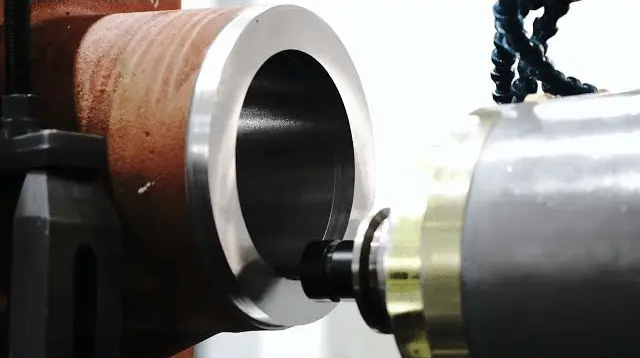 The microscopic geometric structure and dynamic performance of processing tools are another core factor determining the surface finish. In the honing process of automotive engine cylinder blocks, using ultra-fine abrasive strips made of diamond or cubic boron nitride with a particle size ranging from 5 to 15 microns and performing fine honing at a double reciprocating stroke frequency of 200 times per minute can form cross-mesh patterns with an Angle of 40 to 60 degrees on the surface of the cylinder bore. This specific texture structure can increase the retention of lubricating oil by approximately 25%, reduce the friction coefficient between the piston rings and the cylinder wall by 15%, and ultimately improve the fuel economy of the engine by about 3%. This means saving thousands of tons of fuel annually in a production scale of one million units.
Ultimately, what ensures outstanding surface quality is an ecosystem that integrates technology, management and data analysis. For instance, in the manufacturing of high-end optical device molds, an authoritative industry research report indicates that by implementing statistical process control methods and conducting real-time monitoring and correlation regression analysis on over 20 key parameters such as the spindle vibration of machining centers, coolant temperature and concentration, the standard deviation of intra-batch fluctuations in surface quality has been reduced by 60%. This predictive maintenance and process optimization strategy based on big data has reduced the scrap rate caused by surface defects from the traditional 5% to below 0.5%. Although the initial investment has increased by 20%, the overall quality cost has dropped by 35% within 12 months, achieving a dual breakthrough in quality and efficiency.
The microscopic geometric structure and dynamic performance of processing tools are another core factor determining the surface finish. In the honing process of automotive engine cylinder blocks, using ultra-fine abrasive strips made of diamond or cubic boron nitride with a particle size ranging from 5 to 15 microns and performing fine honing at a double reciprocating stroke frequency of 200 times per minute can form cross-mesh patterns with an Angle of 40 to 60 degrees on the surface of the cylinder bore. This specific texture structure can increase the retention of lubricating oil by approximately 25%, reduce the friction coefficient between the piston rings and the cylinder wall by 15%, and ultimately improve the fuel economy of the engine by about 3%. This means saving thousands of tons of fuel annually in a production scale of one million units.
Ultimately, what ensures outstanding surface quality is an ecosystem that integrates technology, management and data analysis. For instance, in the manufacturing of high-end optical device molds, an authoritative industry research report indicates that by implementing statistical process control methods and conducting real-time monitoring and correlation regression analysis on over 20 key parameters such as the spindle vibration of machining centers, coolant temperature and concentration, the standard deviation of intra-batch fluctuations in surface quality has been reduced by 60%. This predictive maintenance and process optimization strategy based on big data has reduced the scrap rate caused by surface defects from the traditional 5% to below 0.5%. Although the initial investment has increased by 20%, the overall quality cost has dropped by 35% within 12 months, achieving a dual breakthrough in quality and efficiency.
The microscopic geometric structure and dynamic performance of processing tools are another core factor determining the surface finish. In the honing process of automotive engine cylinder blocks, using ultra-fine abrasive strips made of diamond or cubic boron nitride with a particle size ranging from 5 to 15 microns and performing fine honing at a double reciprocating stroke frequency of 200 times per minute can form cross-mesh patterns with an Angle of 40 to 60 degrees on the surface of the cylinder bore. This specific texture structure can increase the retention of lubricating oil by approximately 25%, reduce the friction coefficient between the piston rings and the cylinder wall by 15%, and ultimately improve the fuel economy of the engine by about 3%. This means saving thousands of tons of fuel annually in a production scale of one million units.
Ultimately, what ensures outstanding surface quality is an ecosystem that integrates technology, management and data analysis. For instance, in the manufacturing of high-end optical device molds, an authoritative industry research report indicates that by implementing statistical process control methods and conducting real-time monitoring and correlation regression analysis on over 20 key parameters such as the spindle vibration of machining centers, coolant temperature and concentration, the standard deviation of intra-batch fluctuations in surface quality has been reduced by 60%. This predictive maintenance and process optimization strategy based on big data has reduced the scrap rate caused by surface defects from the traditional 5% to below 0.5%. Although the initial investment has increased by 20%, the overall quality cost has dropped by 35% within 12 months, achieving a dual breakthrough in quality and efficiency.